


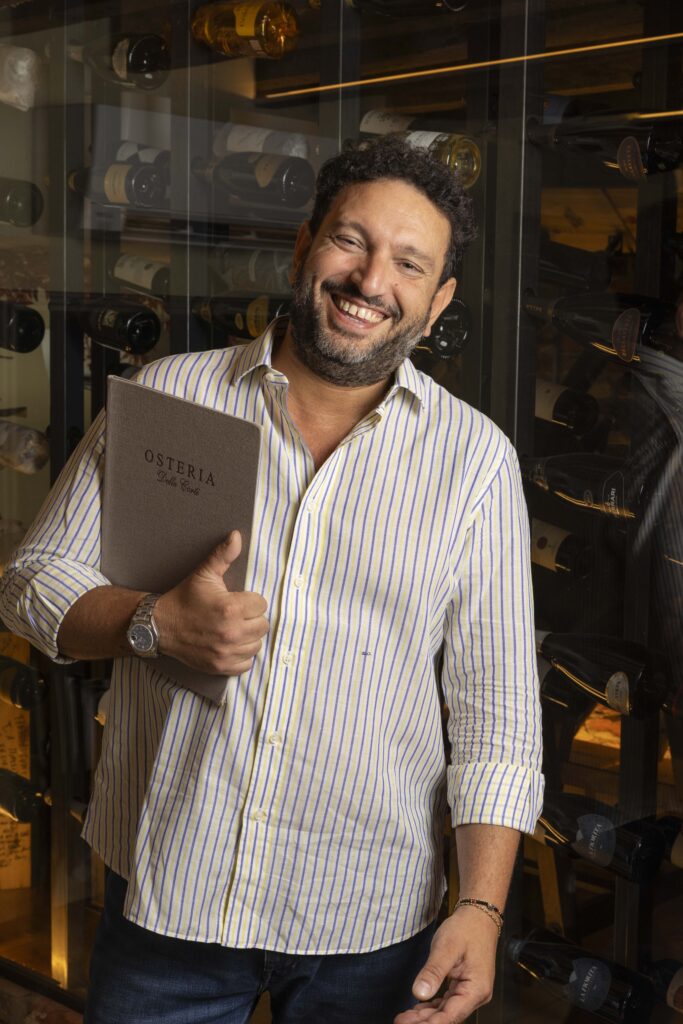
Silvio Oliva, manager of Osteria delle Corti, discusses what it means today to welcome guests, select a wine, and refresh the cuisine without losing one’s identity.
There is one thing that, more than any other, defines a restaurant: the way it makes people feel when they walk through the door. Even before the menu, even before the wine list, there is the hospitality. And this is precisely where Silvio begins when speaking about Osteria delle Corti.
Silvio, in your opinion, what is the one thing people should find when they walk into Osteria delle Corti?
Definitely attention and care. The chance to enjoy a wonderful experience, to feel welcomed and at ease. And then there’s everything we can share through wine.
I personally curate the wine list and enjoy looking for hidden gems: unique wines, perhaps linked to small indigenous grape varieties or lesser-known regions. There are wines with interesting stories behind them, such as those aged in amphora or concrete, and for an enthusiast, it is wonderful to be able to share that.
In the end, it’s not just about drinking good wine, but also about having a story to tell.
Has the way people approach wine changed over the years?
The approach to wine has changed, just as the approach to food has. There has been an enormous evolution.
Cuisine today is much more fusion-influenced. We also offer great classics that are slightly revisited, without distorting them. I am thinking, for example, of the marinated salmon, which today we can pair with a passion fruit mayonnaise: a fusion that completely changes how a dish is interpreted.
Wine, on the other hand, tends to follow fashion cycles: there are periods when the great classics return and others where there is a greater search for refinement.
For those working with Italian clientele, having a story to tell about a wine can be an added value.
So, there is a lot of research behind a wine list.
Absolutely. A wine list requires attention and care, exactly like the menu.
Choosing a wine does not necessarily mean looking for the most famous one. If I need to add something new, I might look for a less represented region or try to move away from the usual names.
Take Piedmont, for example: besides Nebbiolo and Barbera, one can look for a Freisa or a Roero Rosso. They offer different nuances, even when the base grape is the same.
The interesting part is finding something unique that you can then describe to the person in front of you.
And how much does your personal taste influence these choices?
It certainly plays a role, as I curate the list myself. But the point is not to choose a wine for me: I want to be able to tell its story and help guests discover something more.
Does the same apply to the cuisine?
Yes, and it’s perhaps even more difficult. You need to understand where you are and what the character of the restaurant is. You can reinterpret a dish and make it more contemporary, but without overdoing it.
For me, the difficulty lies exactly there: being able to present dishes in a modern key without compromising the true essence of the establishment. Research is essential, but it must be consistent with the restaurant’s identity.
And how does this research begin? Where do the ideas come from?
Definitely from comparing and traveling around.
It’s impossible to think you’re the best at everything. You always draw inspiration from other people, other restaurants, and other ways of working. Then you add your own touch and develop the idea according to your own sensibility.
One of the main sources of inspiration is precisely this: traveling, tasting, and visiting other places.
Do you happen to meet people who are particularly passionate about wine, looking for something more refined?
It doesn’t happen very often, but when it does, it’s a great occasion.
At its core, there must be the pleasure of doing this job. If you take pleasure in it, it shows.
Is this a philosophy you also try to pass on to your team?
Yes. That’s what I always tell the staff: you have to put yourself in the shoes of whoever comes here and ask yourself what you would want to find, if you were sitting at that table.
It is a simple thing to say, but not necessarily a simple thing to do.
So, in the end, what does it mean to do this job well?
It is a simple job, but you have to know how to do it. The difference lies entirely in the attention you put into things: in the hospitality, in the service, in the way you describe a wine or present a dish.
And above all, in reminding you that, in the end, everything you do is for the person in front of you.
Perhaps that is precisely the point: you don’t always need to amaze. Sometimes it is enough to do things well, with care, and make someone feel they are in the right place.

